Background:
With Financial Inclusion emerging as a major policy component in the country, microfinance through its inclusive financial services is seen as one of promising tools to reach out to the unbanked populations. Delivered mainly through the MFI channel and with its focus on financial and social aspects; microfinance contributes significantly to expand financial inclusion by offering need based financial services including micro credit, micro insurance and pension services etc. to low income groups of people, with a focus on Women SHG/JLG Members. Over the years’ microfinance has progressed well in the country. As per MFIN Report, microfinance operations are present in 718 Districts across 28 states and 08 union territories of the country. The microfinance industry has total loan portfolio of about Rs 3,28,708 Cr, with 6.3 unique borrowers in India. Altogether 211 entities including 97 NBFCs, 86 NBFC-MFIs, 18 Banks and 10 SFBs are operating in the microfinance sector of the country as on June’2026.
The state of Odisha has emerged as a potential microfinance market in the eastern region of the country and projected a rich diversity of microfinance models, practices, tools and products etc. The role of MFIs in providing the financial services for the poor has been quite encouraging, especially in terms of their outreach and service delivery at the door steps of the members. Having adopted various customers’ friendly methodologies including SHG and JLG, microfinance has been able to reach out to a large section of people, particularly women members in the state.
As reported, more than 100 institutions, including NBFCs, NBFC-MFIs and Small Finance Banks (SFBs) operate in Odisha, delivering key financial products and services including micro-credit and micro-insurance services to low-income populations. Following rapid national expansions and a deep subsequent industry-wide consolidation phase driven by stricter regulatory caps on borrower over-leveraging, the state's credit risk indicators got improved further. As per Sa-Dhan Report, MFIs collectively cover all 30 districts in Odisha, reaching out to over 31.99 lakhs unique customers with gross loan portfolio of around Rs. 16,730 Cr in the state. There are about 1500 microfinance Branches across the state in which around 12,000 staff have been working. Thus, microfinance along with providing micro credit to the customers, has also been able to create employment opportunities for many educated and unemployed youth. So also the Customers who avail microcredit found to be utilizing that for various economic activities to earn an enhanced income for their respective households. Member MFIs usually borrow loan funds from various Banks and Investors and on-lend that to the microfinance customers. Thus, the loan funds from various lending institutions and development banks like SIDBI, NABARD, Policy framework from RBI and guidance from Government have been quite helpful for the growth of microfinance sector across India and also in the state of Odisha.
Odisha State Association of Financial Inclusion Institutions Trust (OSAFIIT):
Founding & Vision- Establishment: Registered as a formal Trust in 2016 by a collaborative network of home-grown Microfinance Institutions (MFIs).
- Popular Identity: Widely recognized and publicly referred to by its popular acronym, OSAFII.
- Core Objective: Set up to drive seamless coordination among all sector stakeholders and fundamentally strengthen the inclusive finance ecosystem across Odisha.
- Common Platform: Provides a unified, state-level platform for diverse microfinance stakeholders to share institutional experiences, field insights, and best practices.
- Better Coordination: Eliminates operational silos by facilitating stronger integration and collaborative communication among members, regulators, and government bodies.
- Addressing Challenges: Actively works to resolve state-specific operational bottlenecks, localized policy hurdles, and financial delivery issues.
- Capacity Building: Enhances the skills and domain knowledge of member organizations and grassroots stakeholders through targeted training programs.
- Responsible Finance: Drives widespread institutional alignment with ethical industry standards, including Responsible Finance frameworks, strict Codes of Conduct, and Client Protection Principles.
Key Priorities and Program Focus of OSAFII
- Networking & Coordination: To coordinate and build collaborative efforts among all stakeholders for strengthening further the financial inclusion sector in Odisha.
- Capacity Building of Members & Stakeholders: To design and offer customized technical assistance including demand-based trainings for member organizations & other stakeholders.
- Promote Industry Standards & Best Practices: To encourage and educate member organizations and help them proactively practice the Responsible Finance, SRO Principles & SPM processes in their respective microfinance programs.
- Policy Advocacy: To take up policy and other issue-based advocacy with Government, policy makers and regulators for strengthening further the enabling environment in the state.
- Knowledge Management: To ensure regular collation of web based and other relevant information on financial inclusion, microfinance, livelihood promotion and dissemination that with members and stakeholders.
Governance & Management:
Two-Tier Governance System- General Body: Comprises heads of all member institutions and MFIs within the state, ensuring equal participation and democratic governance.
- Board of Directors & Trustees: Consists of 13 elected members who oversee the strategic direction of the association.
- Regular Meetings: The Board meets on a quarterly basis to review progress and address evolving sector dynamics.
- Strategic Deliberations: Debates critical sector-wide agendas, programmatic challenges, and regulatory updates.
- Collective Resolutions: Operates on a collaborative consensus model to make all high-level policy and operational decisions.
- Professional Management: Led by a recruited Chief Executive Officer (CEO) who manages the day-to-day administrative affairs.
- Program Coordination: The CEO is responsible for planning, deploying, and tracking OSAFII’s field initiatives.
- Stakeholder Liaison: Drives seamless cooperation and synergy among member organizations, funding bodies, and government stakeholders.
Key Stakeholders:
Strategic Anchor & Funding Partner- SIDBI (Small Industries Development Bank of India): Serves as a foundational stakeholder and primary institutional partner since OSAFII's inception.
- Incubation Support: Extended critical financial funding through its Poorest States Inclusive Growth (PSIG) programme to formally set up and register the OSAFII Trust.
- Technical Assistance: Facilitated technical expertise and capacity building during the initial setup phase by engaging ACCESS-ASSIST.
- Strategic Grants: Partnered via formal Grant Agreements to fuel OSAFII's widespread sector-building initiatives and professional development activities across the state.
- Flagship Enterprise Programs: Funded the execution of the impactful WE-LEAD (Women Entrepreneurship-Livelihood Enhancement And Development) initiative, targeting the development of 12,000 women entrepreneurs primarily across five Aspirational Districts in Odisha.
- Banking & Financial Regulators: Works in close alignment with the Regional Office of the Reserve Bank of India (RBI) and NABARD to ensure strict regulatory compliance and sector stability.
- Apex Financial Bodies: Collaborates continuously with the State Level Bankers' Committee (SLBC), mainstream commercial banks, and Business Correspondents (BCs) to enhance credit access and financial infrastructure.
- Directorate of Institutional Finance: Partners on state-level policy framing, microfinance monitoring, and inclusive credit delivery strategies.
- Livelihood & Empowerment Missions: Operates in lockstep with Odisha Livelihoods Mission (OLM/NRLM), Mission Shakti (Department of WCD), and SUDA/NULM to drive grassroots women empowerment, rural livelihood advancement, and urban poverty alleviation.
Members of OSAFII:
OSAFII is a member-based organization.
Founding & Membership Growth- Founding Members: Formed initially by seven home-grown entities in Odisha: Annapurna Finance Pvt Ltd, GU Financial Services Pvt Ltd, Adhikar Microfinance Pvt Ltd, Mahashakti Foundation, Swayamshree Microcredit Services, Sambandh Finserve Pvt Ltd, and Swayamshree Mahila Samabaya Ltd.
- Current Strength: Expanded over time to include national-level organizations, currently comprising 28 members (20 NBFC-MFIs, 4 NBFCs, and 2 SFBs) operating in Odisha.
- Institutional Footing: This growing membership base provides the mandate, legitimacy, and scale required to drive impactful work across both the state and the country.
- Regulatory Compliance: Most member organizations are registered with the Reserve Bank of India (RBI).
- Double Bottom Line: Dedicated strictly to achieving a balance of social development and financial sustainability for the poor.
- Core Products: Actively deliver microcredit, small business loans, and microinsurance services.
- Community Development: Undertake diverse welfare programs covering health, hygiene, water, sanitation, education, and rural housing.
- Sustainability & Growth: Drive grassroots enterprise promotion, solar/green energy adoption, climate change awareness, and environmental protection.
- Crisis Response: Lead targeted relief and rehabilitation efforts for affected communities during post-cyclone periods.
- Cyclone Fani Impact: Provided emergency relief materials valued at over ₹5 crores directly to affected victims.
- State Contribution: Donated ₹31.11 lakhs to the Chief Minister's Relief Fund in Odisha to support recovery efforts.
Key Activities undertaken by OSAFII:
Since its inception, OSAFII has been undertaking various sector and capacity building activities for the Members, Customers and Stakeholders in the state.
Internal Governance & Coordination- Holds regular, quarterly Board and Members’ Coordination meetings.
- Convenes the Annual General Body Meeting alongside specialized, need-based sessions.
- Organized 8 mega events, featuring 7 state-level Financial Inclusion (FI) Conclaves and 1 SHG Convention.
- Mobilised over 1,000 Women SHG/JLG members from every district in Odisha for the landmark SHG Convention.
- Published and launched the annual Odisha Inclusive Finance Status Reports in partnership with CRIF-High Mark and Equifax Credit Bureaus.
- Brought together delegates at FI Conclaves from the Government, Reserve Bank of India (RO-RBI), NABARD, SIDBI, SLBC, banks, NBFC-MFIs, SFBs, NGOs, and academic bodies.
- Drove strategic deliberations on key topics like financial inclusion, credit delivery, women's empowerment, and rural livelihood promotion.
- Conducted district-level coordination meetings to improve convergence among local stakeholders and scale up micro-enterprise expansion.
- Facilitated routine media briefings and interactive sessions with state journalists and police personnel.
- Disseminated targeted training programs to upgrade the knowledge, skills, and overall understanding of member organization personnel.
- Partnering with individual experts and resource persons from reputed institutions, the association conducted a comprehensive series of educational workshops covering key operational and social domains.
- These sessions specifically focused on Gender Mainstreaming, Stress Management, Responsible Lending, and adherence to the Code of Conduct.
- Additionally, the modules integrated critical sector principles such as Clients’ Protection Principles, Risk Management, Human Resource Development (HRD), Enterprise Development & Management, and foundational strategies surrounding Financial Inclusion and Financial/Digital Literacy.
- Partnered with individual experts and resource persons from reputed institutions to facilitate these educational workshops.
Women Entrepreneurship-Livelihood Enhancement And Development (WE-LEAD) programme:
With a noble intention and strategy to address the above issues, the Small Industries Development Bank of India (SIDBI), under its Mission Swavalamban initiatives, launched the Women Entrepreneurship-Livelihood Enhancement And Development (WE-LEAD) Programme in India/Odisha.
Programme Overview & Objectives- Strategic Partnership: Launched by the Small Industries Development Bank of India (SIDBI) under its Mission Swavalamban initiative and implemented by OSAFII in collaboration with its member organisations.
- Timeline & Scope: Phase I was successfully executed from April 2022 to December 2025 across six key districts in Odisha: Kalahandi, Balangir, Kandhamal, Gajapati, Dhenkanal, and Khordha.
- Core Intent: Aimed to empower 12,000 women Self-Help Group (SHG) and Joint Liability Group (JLG) members by scaling existing businesses and incubating new enterprises.
- Holistic Approach: Combined Entrepreneurship Development Programmes (EDP), trade-specific skill training, financial literacy sessions, credit facilitation, mentoring, and market linkages.
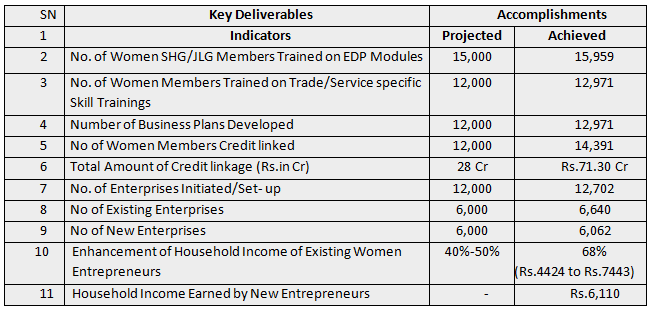
- Exceeded Training Targets: Delivered comprehensive EDP training to 15,959 SHG/JLG members and trade-specific skill training to 12,971 potential women entrepreneurs.
- Enterprise Transformation: Supported 12,702 women entrepreneurs in strengthening their businesses, successfully launching 6,062 new enterprises and scaling 6,640 existing ones.
- Market Integration: Organized 18 Buyers-Sellers Meets, exhibitions, and networking platforms to connect grassroots entrepreneurs with markets.
- Localized Content: Developed structured training manuals, toolkits, and IEC materials in the local language (Odia) to support long-term learning and retention.
- Phase I Infrastructure: Executed foundational baseline surveys, inception meetings, Training of Trainers (ToT), refresher programmes for project and MFI staff, business plan development, and Mid-Term Reviews (MTR).
- Phase II Expansion: Extended operations into 12 new blocks within the active 6 districts during the second year, replicating baseline surveys, ToTs, and advanced credit linkage coordination.
- Continuous Governance: Facilitated ongoing Project Advisory Committee (PAC) meetings, stakeholder liaisoning, strict programme monitoring, and dedicated mentoring for the women entrepreneurs.
- Future Vision: Planning to expand the footprint of the impactful WE-LEAD model to other districts and states. OSAFII envisages for transforming itself as a potential state actor in the domains of financial inclusion and enterprise promotion and for that it seeks cooperation from various institutions, partners and support organizations to achieve that goal in the state/country.